AngerToZen
Transform your Anger into Zen using this simple no-fuss anger log tool.

Transform your Anger into Zen using this simple no-fuss anger log tool.
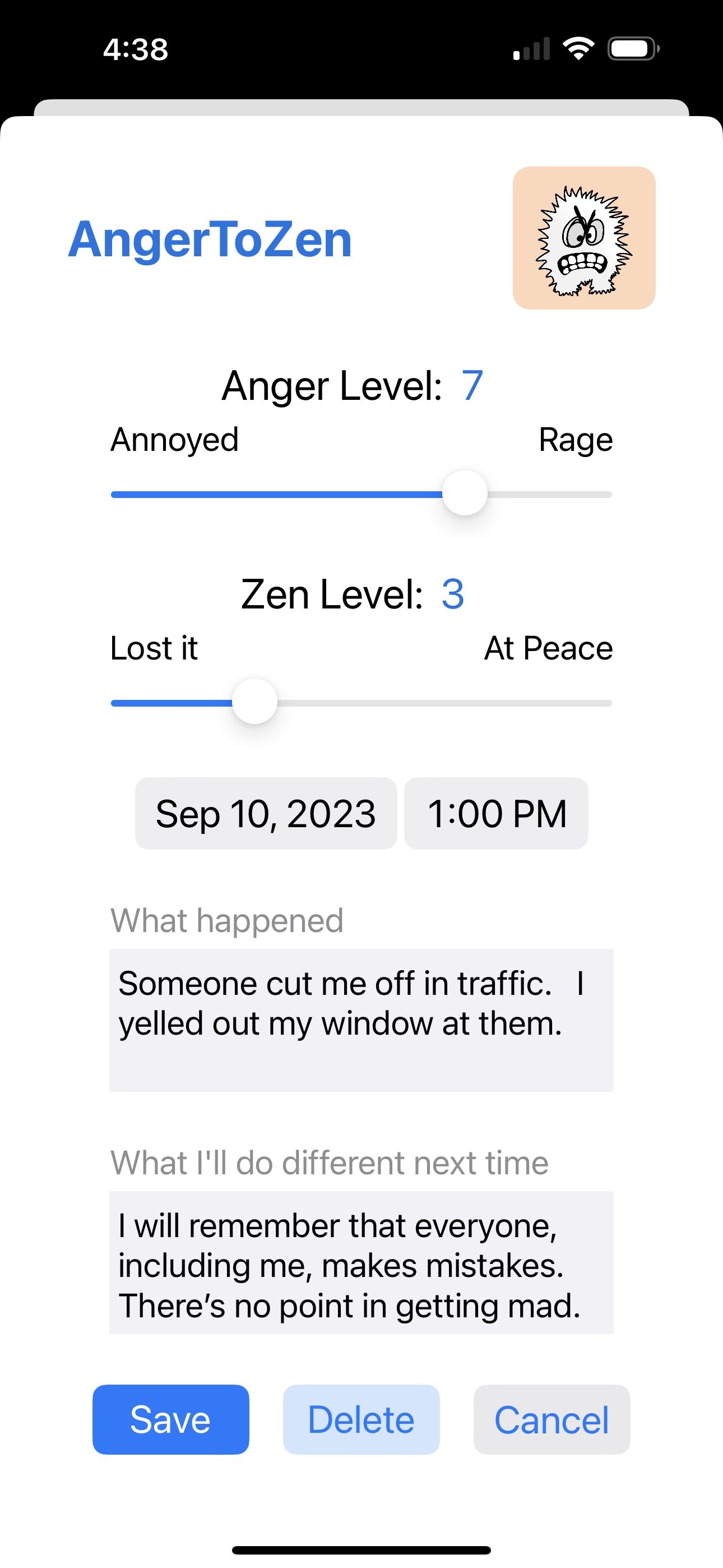
AngerToZen is a simple to use tool to track when you get angry, and what you get angry about. You can use it to take note of your level of anger, and how you did (or didn't) maintain a state of zen. The dashboard helps you see how many anger events happened in the past week or month.


Please get in touch at support@angertozen.com if you have any questions or if you have any problems using the app.
J Goto built the AngerToZen app as a Free app. This SERVICE is provided by J Goto at no cost and is intended for use as is.
This page is used to inform visitors regarding my policies with the collection, use, and disclosure of Personal Information if anyone decided to use my Service.
If you choose to use my Service, then you agree to the collection and use of information in relation to this policy. The Personal Information that I collect is used for providing and improving the Service. I will not use or share your information with anyone except as described in this Privacy Policy.
The terms used in this Privacy Policy have the same meanings as in our Terms and Conditions, which are accessible at AngerToZen unless otherwise defined in this Privacy Policy.
For a better experience, while using our Service, I may require you to provide us with certain personally identifiable information. The information that I request will be retained on your device and is not collected by me in any way.
The app may use third-party services that may collect information used to identify you.
I want to inform you that whenever you use my Service, in a case of an error in the app I may collect data and information (through third-party products) on your phone called Log Data. This Log Data may include information such as your device Internet Protocol (“IP”) address, device name, operating system version, the configuration of the app when utilizing my Service, the time and date of your use of the Service, and other statistics.
I value your trust in using the Service, thus we are striving to use commercially acceptable means of protecting information that you enter. But remember that no method of transmission over the internet, or method of electronic storage is 100% secure and reliable, and I cannot guarantee its absolute security.
I may update our Privacy Policy from time to time. Thus, you are advised to review this page periodically for any changes. I will notify you of any changes by posting the new Privacy Policy on this page.
This policy is effective as of 2023-09-27.
If you have any questions or suggestions about my Privacy Policy, do not hesitate to contact me at support@angertozen.com.